
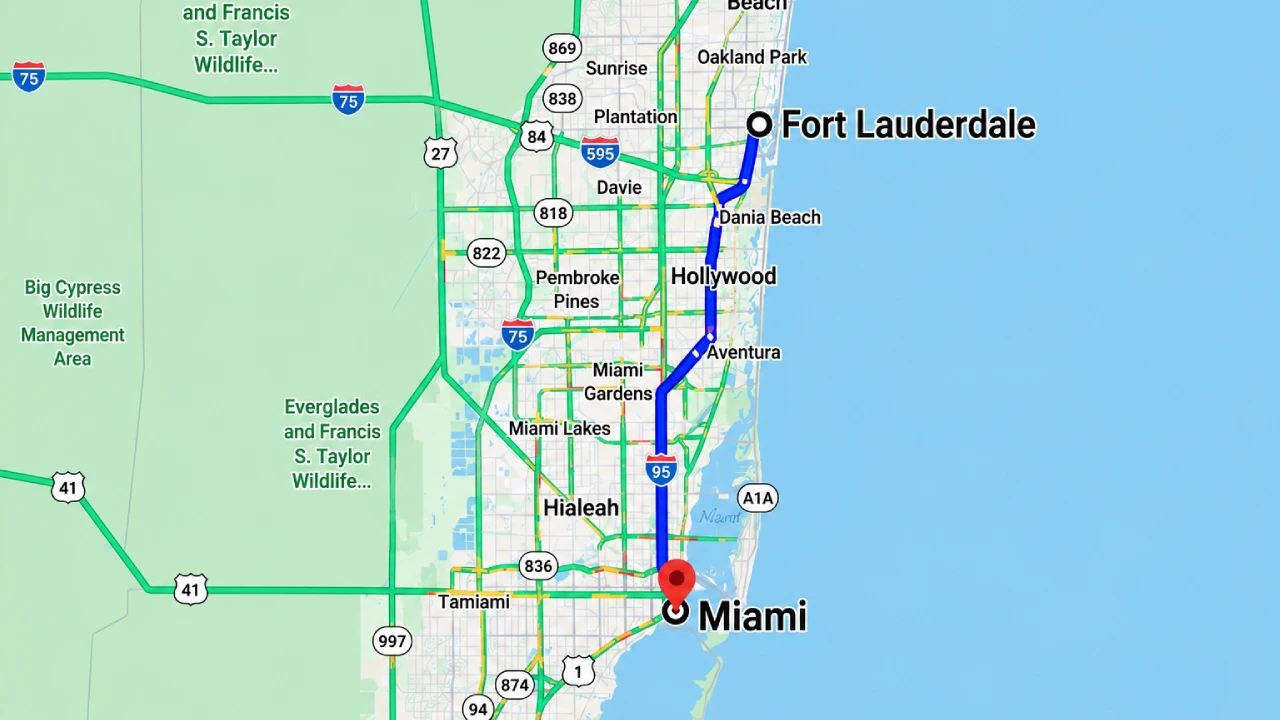
The Fort Lauderdale to Miami drive covers approximately 28 to 30 miles and typically requires 30 to 45 minutes under normal conditions. Despite the short distance, this route is among the most heavily traveled in South Florida, and traffic conditions affect travel time more than the mileage. Both cities are within the greater Miami metropolitan area, connected by a network of interstates, surface roads, and coastal highways, which gives travelers several route options depending on choices around speed, cost, or surroundings.
Route Options Between Fort Lauderdale and Miami
Travelers can access multiple routes to complete the Fort Lauderdale to Miami drive.
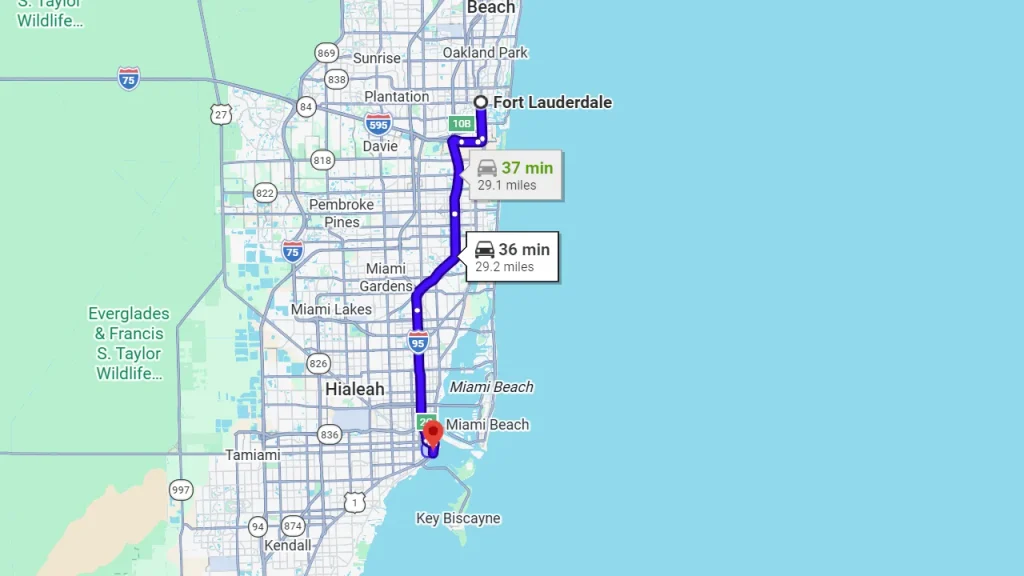
- Distance: Approximately 28 to 30 miles
- Travel Time (Light traffic): 30 to 40 minutes
- Travel Time (Peak Hour): 45 to 60 minutes
- Primary Route: Interstate 95 South/North
- Alternative Routes: Florida's Turnpike, US-1, A1A
- Tolls: Optional on I-95 Express Lanes; required on Florida's Turnpike
Interstate 95
I-95 is the most direct and most commonly used route connecting the two cities, running parallel to the coastline through Broward and Miami-Dade counties. The interstate offers consistent signage and a straightforward path, with numerous exits providing access to Fort Lauderdale, Aventura, North Miami, and downtown Miami.
- No tolls in the general lanes; optional Express Lanes are available for a fee for drivers who want to bypass slower traffic
- Carries the bulk of commuter and commercial traffic in this corridor
- Tends to see the most significant slowdowns during peak periods, a tradeoff for its otherwise direct path
Florida's Turnpike
Florida's Turnpike offers an alternative to I-95, running slightly inland and generally seeing less congestion, particularly during peak commuting hours.
- Tolls apply for the entire length of this route
- Better suited to drivers already equipped with a SunPass transponder, since toll-by-plate rates run higher
- Fewer exits than I-95 along this stretch, making it a more consistent option for drivers who don't need to stop along the way
US-1 (Federal Highway)
US-1, also called Dixie Highway or Federal Highway depending on the segment, offers a surface-street alternative that passes through numerous cities and neighborhoods rather than bypassing them.
- More traffic signals and lower speed limits than the interstate options, making it slower overall
- Useful when I-95 experiences significant delays or closures
- Provides more direct access to smaller municipalities along the way, useful for travelers with business or errands outside the two main cities
A1A Coastal Route
For travelers less concerned with speed, A1A follows the coastline through Fort Lauderdale Beach, Hollywood Beach, and Sunny Isles before reaching Miami Beach.
- Takes considerably longer than the inland alternatives
- Heavier congestion near beach areas, particularly on weekends
- Offers ocean views not available on the interstate
- Drawbridges near Hollywood and Sunny Isles can add unpredictable delays when open for passing boat traffic
Map of Fort Lauderdale to Miami
Traffic Patterns to Expect
Traffic conditions along this corridor fluctuate considerably by both time of day and day of the week.

- Weekday rush hours, generally between 7:00 and 9:30 a.m. and again between 4:00 and 6:30 p.m., bring the heaviest congestion, particularly near the I-95/I-595 interchange in Fort Lauderdale and the approach into downtown Miami.
- Weekend afternoons see lighter commuter traffic but can still slow considerably near beach access points and major shopping destinations.
- Major events, including games at Hard Rock Stadium or concerts in either city, can extend travel times well beyond typical rush-hour delays.
- Afternoon thunderstorms, common in South Florida from late spring through early fall, frequently slow traffic along the entire I-95 corridor with little advance warning.
- Seasonal tourism patterns during the winter and early spring months generally bring heavier traffic throughout South Florida as visitor volume increases across both cities.
- Ongoing construction projects, common along this stretch of I-95 and the Turnpike, can shift lane closures and typical bottleneck locations from one month to the next, making real-time traffic information more reliable than fixed expectations.
Tolls on This Route
Toll costs on this drive depend entirely on which route a traveler chooses.
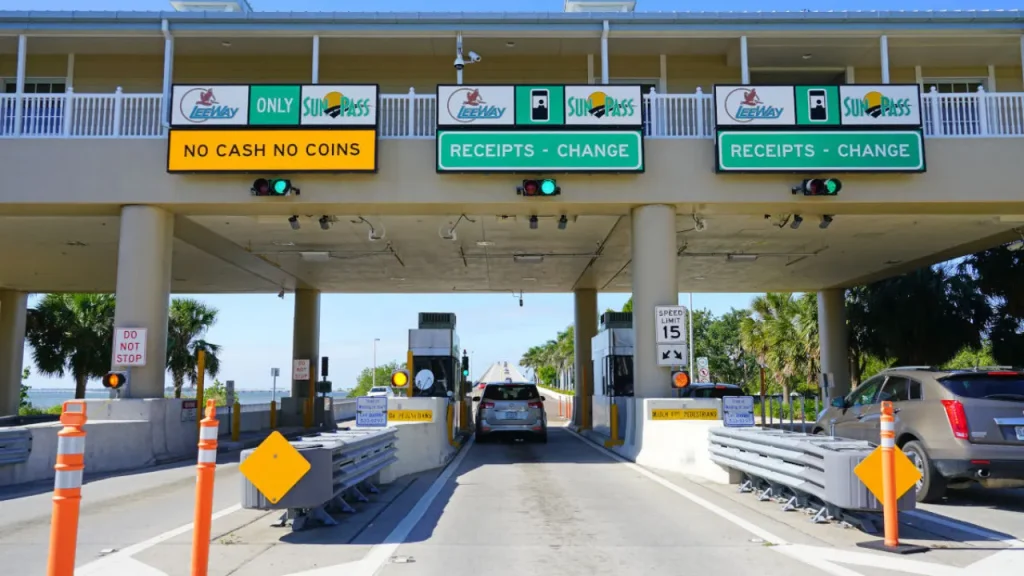
- I-95 general lanes: no tolls
- I-95 Express Lanes: a variable fee based on demand, requiring a SunPass or compatible transponder since cash isn't accepted
- Florida's Turnpike: tolls for the entire length, regardless of lane choice
Rental vehicles vary in how they handle toll billing, so confirming this in advance is advisable for anyone planning to use either the Express Lanes or the Turnpike.
Driving Conditions on Fort Lauderdale to Miami Drive
A few conditions specific to this corridor are worth factoring into a trip beyond standard traffic volume.
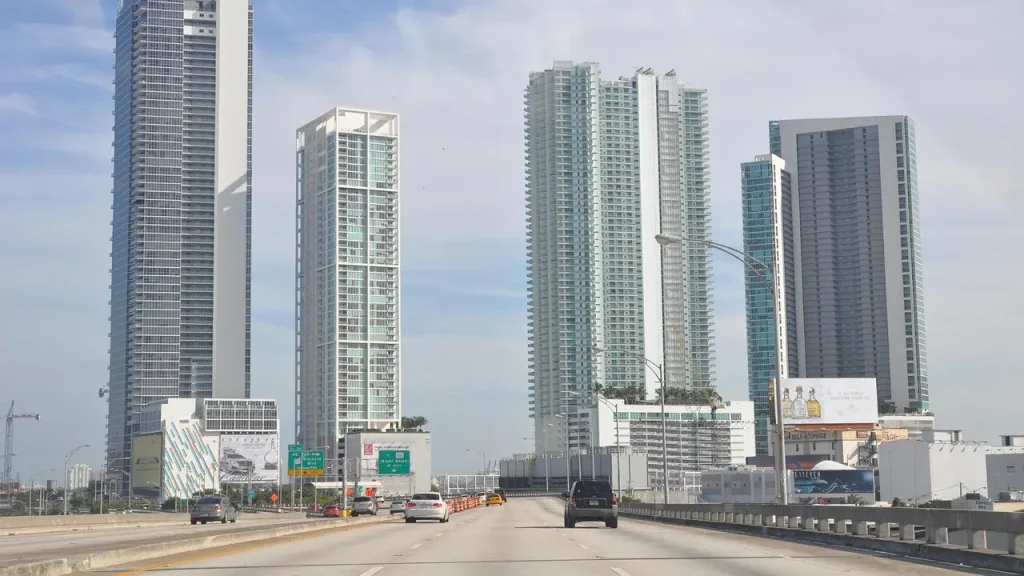
- Lane shifts near construction zones are common along both I-95 and the Turnpike in this stretch, and posted speed limits within active work areas are enforced more strictly than elsewhere
- Merging traffic near major interchanges requires extra attention, particularly where I-595 meets I-95 in Fort Lauderdale and where I-95 splits toward I-395 (MacArthur Causeway) and I-195 (Julia Tuttle Causeway) toward Miami Beach, since lane changes in these areas happen quickly and with little advance notice
- Visibility during sudden rain showers can drop significantly within a short span, so reducing speed during these periods is advisable given the corridor's overall traffic density
Airports Along the Route
Both Fort Lauderdale-Hollywood International Airport (FLL) and Miami International Airport (MIA) sit close to this route, which makes the corridor relevant for travelers connecting between flights or picking up a rental vehicle at one airport for use in the other city.
- FLL sits just west of I-95 near the northern end of the drive
- MIA sits closer to the western edge of Miami, a short distance from I-95's southern terminus
- Rental pickup and return locations at both airports are easily accessible from the interstate
Travelers flying into one airport with plans to spend time in the other city commonly factor this drive into their itinerary.
Parking Upon Arrival in Miami
Parking availability in Miami depends heavily on the destination.
- Downtown Miami and Brickell offer numerous paid garages, generally the most reliable option during business hours
- Miami Beach parking tends to be more limited and often carries higher rates, particularly in South Beach during peak season
- Hotels frequently charge a separate daily parking fee, which is worth confirming in advance for anyone staying overnight
Best Times to Make Fort Lauderdale to Miami Drive
Traveling outside of standard weekday commuting hours produces the most predictable results. Mid-morning, after the morning rush concludes, and mid-afternoon, before the evening commute begins, tend to offer the smoothest conditions. Travelers with flexible scheduling may also find that arriving in Miami before 7:00 a.m. or after 7:00 p.m. avoids the bulk of the corridor's daily congestion.

Considerations for Renting a Vehicle for This Drive
A few factors should be reviewed before renting a car in Fort Lauderdale, specifically for travel between these two cities.
- Given the short distance, mileage limits are rarely a concern, though confirming the rental agreement's terms remains good practice
- Toll handling varies by rental company; clarify whether a transponder is included and how charges are billed if the Express Lanes or Turnpike are used
- One-way rentals between the two cities are offered by many providers but often carry an additional fee, which should be confirmed at the time of booking
- Given the traffic patterns described above, building in extra time beyond the estimated 30 to 45 minutes is a reasonable precaution regardless of rental provider
Alternatives to Driving
For travelers who prefer not to drive, Brightline offers a higher-speed passenger rail option between Fort Lauderdale and Miami, with a travel time generally under 30 minutes, not accounting for traffic. This alternative avoids road congestion entirely, which may appeal to travelers arriving during peak traffic periods. However, it takes additional time to check in and board the train, while having a car provides more flexibility.
Summary
Although the distance of the Fort Lauderdale to Miami drive is relatively short, traffic conditions along the route affect timing more than mileage. Interstate 95 serves as the direct route, while Florida's Turnpike, US-1, and A1A provide alternatives based on considerations of speed, toll costs, or scenery. Travelers should plan ahead of their trip, particularly around peak traffic periods, toll arrangements, and additional time allowances.
Frequently Asked Questions
How far is Fort Lauderdale from Miami?
How long does the drive from Fort Lauderdale to Miami take?
What is the fastest route between Fort Lauderdale and Miami?
Are there tolls between Fort Lauderdale and Miami?
Is it better to drive or take the train between Fort Lauderdale and Miami?
Do rental cars picked up at Fort Lauderdale Airport allow drop-off in Miami?
How does construction affect this drive?
Kairav Norell
Kairav Norell is an automotive content researcher at FortLauderdaleCarRentals, focused on rental terms, vehicle availability, and regional pickup logistics across South Florida. Her background in transportation studies shapes how she approaches each article, breaking down policies and procedures that often get buried in fine print. Kairav covers the practical side of renting a car: deposit requirements, age restrictions, fuel policies, and how pickup locations differ between airport counters and neighborhood branches. She works from official rental agreements and carrier guidelines rather than assumptions, so readers get information that holds up when they're actually standing at the counter.